 Local Government
 Education
 Government
 Health and Community Services
 Asset and Project Intensive Industries
 Financials and Corporate

 App Builder
 Business Analytics
 Corporate Performance Management
 Curriculum Management
 DxP Essentials
 Enterprise Asset Management
 Enterprise Budgeting
 Enterprise Cash Receipting
 Enterprise Content Management
 Financials
 Human Resources
 Payroll
 Performance Planning
 Property & Rating
 Spatial
 Student Management
 Supply Chain Management
 Timetabling & Scheduling

 About SaaS+
 Our Solutions
 ERP in 30 Days
 Security
 Software Releases
 About Us
 Investor Relations
 Life@Tech1
 Foundation
 Careers
 Login
Login Customer community
 Enterprise App Store
Both use artificial intelligence, but it’s how that matters.
Australia’s AI adoption, seen as a critical component of the government’s Future Made in Australia agenda, is steadily increasing. According to the Australian Government's AI Adoption Tracker, 41% of small and medium enterprises (SMEs) were actively adopting AI as of June 2025, a 5% increase from the previous quarter.
Yet for most organisations, that AI experience is still largely generative: tools like ChatGPT or Copilot that answer questions and produce content on demand.
A newer category is gaining traction: agentic AI. The two terms are often used interchangeably, but they shouldn't be.
This article explains what separates generative and agentic AI, why the distinction matters, and how organisations are already putting agentic AI to work.
On this page:
- The rise of AI in Australia
- What is generative AI?
- What is agentic AI?
- So, what's the difference between agentic and generative AI?
- Generative AI vs agentic AI: pros and cons
- Agentic AI in action: real-world examples
- TechnologyOne's agentic AI products: Plus and Guide
- Frequently asked questions (FAQs): AI, Plus, and more
The rise of AI in Australia
Ever since ChatGPT took the world by storm in 2022, AI adoption rates have increased, faster perhaps than most people even realise.
Starting from a basic household level, AI is now embedded in many people’s everyday lives. A Google and Ipsos survey found that 49% of Australians used generative AI in the past year, up from 38% in 2023. Adobe's research paints a similar picture: paints a similar picture: 66% of Australians are now turning to AI or want to, and one in 3 are using AI assistants regularly - for everything from travel planning and shopping to banking and creative work.
But a shift is underway. Where most of that activity involves generative AI (tools that respond to prompts) Adobe also found that agentic AI usage among Australians leapt 50% in just three months in 2025, with nearly one in five already using it and a further 42% expecting to within the year.
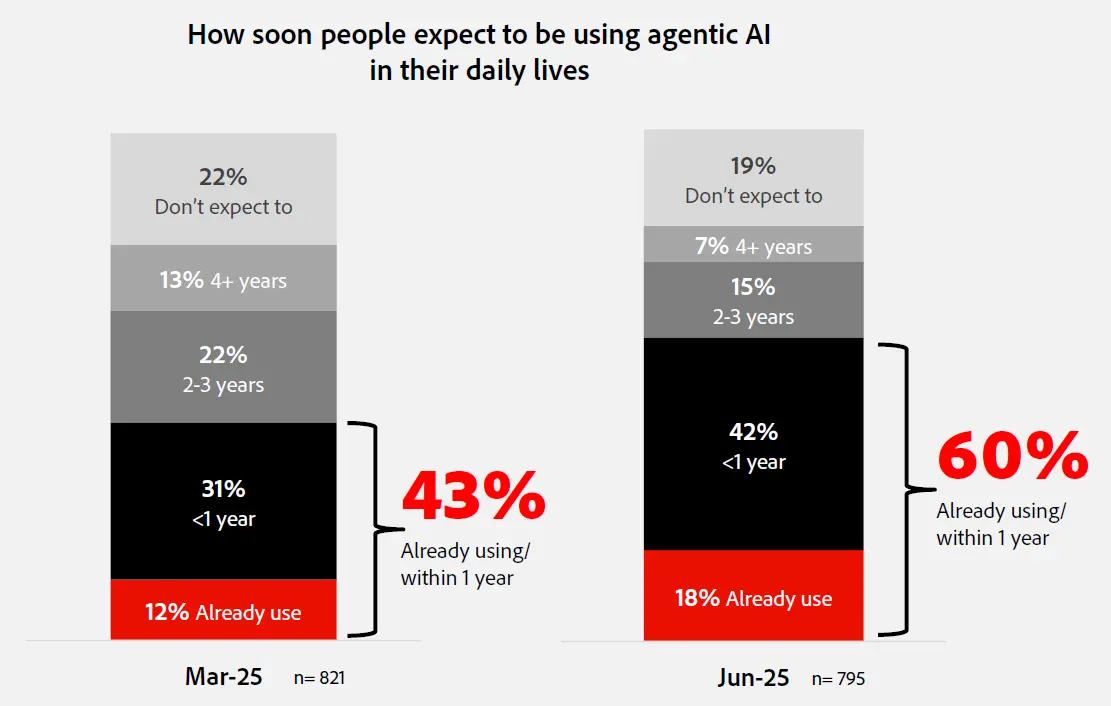
Source: Adobe
The enterprise implications are significant. Gartner projects that by 2028, 33% of enterprise software applications will include agentic AI, up from less than 1% in 2024.
What is generative AI?
Generative AI produces content in response to a prompt. It’s the kind of AI the average person is most familiar with: Ask it a question and it generates an answer; give it a brief and it writes a draft. Show it data and it produces a summary.
Tools like ChatGPT, Microsoft Copilot, and Google Gemini are all famous examples of generative AI. They're useful, widely adopted, and improving by the minute.
But they share one defining characteristic: they respond when asked, and their role ends when the output is delivered.
What is agentic AI?
Rather than responding to a prompt and stopping, agentic AI can:
- Set a goal based on your instruction
- Plan the steps needed to achieve it
- Execute those steps across systems and workflows
- Reflect on the outcome and refine its approach over time
The key word is initiative. Agentic AI doesn't wait for the next instruction - it figures out what needs to happen next and takes the initiative to act on it, while still requiring a human in the loop at critical decision points.
So, what's the difference between agentic and generative AI?
The simplest way to put it: generative AI answers, agentic AI acts.
A generative AI might draft a maintenance report. An agentic AI would draft it, file it, assign it to the right team, check for duplicate requests, and flag it for follow-up - all from a single instruction.
The table below captures the key differences across the dimensions that matter most for enterprise software.
Generative AI vs agentic AI: pros and cons
Generative AI | Agentic AI | |
|---|---|---|
Pros | Widely available and easy to access. Many models have free versions Fast at producing content, summaries, and drafts. Low barrier to entry - no setup required. Useful across a broad range of everyday tasks. | Completes multi-step tasks autonomously Reduces manual effort and system navigation Learns and improves with use Keeps humans in the loop at key decision points |
Cons | Stops at the output - next steps are always manual Requires a new prompt for every action Limited ability to act across systems or workflows Output quality depends heavily on prompt quality | Requires access to your organisation's data and systems to deliver value More powerful, so governance and guardrails matter more Earlier stage of mainstream adoption than generative AI Can cost more than generative AI |
Note: the above is a general comparison. Capabilities vary across individual products and implementations.
Agentic AI in action: real-world examples
Agentic AI is easiest to understand through what it actually does. In practice, that might look like an AI that:
- Monitors inventory levels
- Identifies shortfalls
- Raises purchase orders without being asked
- Checks leave balances and identifies excess leave
- Emails relevant team members (or drafts one for you) and so on.
Or a manager asks Plus for their outstanding tasks. Plus Smart My Tasks retrieves everything assigned to them, groups items by urgency - critical, priority, time-sensitive, or general - and flags approaching deadlines, all in one conversation.
TechnologyOne's agentic AI products: Plus and Guide
TechnologyOne has two agentic AI products purpose-built for the industries it serves:
Both are built on the same secure, Australian-hosted foundation - and both connect directly to your TechnologyOne ERP.
What is Plus?
Plus (Predict, Learn, Uncover, Simplify) is TechnologyOne's first agentic AI product.
It understands natural language, anticipates your team's needs, and acts on their behalf - turning complex enterprise workflows into simple conversations. Whether you ask by text or voice, Plus interprets the request and delivers a result.
There are no screens to navigate, and no complex training is required. The more TechnologyOne products you have, the more powerful Plus becomes.
What is Guide?
Guide extends agentic AI beyond your teams to the people you serve. It gives residents and students a simple, conversational way to access services and find information without having navigating complex portals or forms.
Guide is available in two forms.
- Guide for residents provides a single conversational entry point to council services.
- Guide for students delivers personalised support across the full student journey, from enrolment through to graduation and beyond.
Explore TechnologyOne’s agentic AI today
The shift from generative to agentic AI is underway. Plus and Guide offer organisations in local government and higher education a practical, secure way to move with it.
Agentic AI should operate within clear governance controls, permissions and escalation paths. At TechnologyOne, this is reinforced through our Defence in Depth security architecture, role-based access controls, human-in-the-loop decision checkpoints, and AI guardrails that ensure actions remain aligned to organisational policies and user permissions. Critical decisions remain under human oversight, with AI assisting rather than replacing accountable decision-makers.
Speak with a TechnologyOne team member to find out what our agentic AI products can do to make life simpler for you and your community.
Frequently asked questions (FAQs): AI, Plus, and more
Learn more about our products and solutions by reading some of our FAQs below.
You need to be on the 26A release and using CiA in order to leverage Plus.
Plus works straight out of the box, with zero implementation. Once licenced, simply turn it on using a feature flag enablement and go. When enabled, processes automatically run in the background to configure Plus and its permissions for you.
Plus is built on TechnologyOne’s Defence in Depth security architecture best practice principles, such as 'the human in the loop'. It is underpinned by the ISO 42001:2023 certification, the world’s first global standard for Artificial Intelligent Management Systems.
TechnologyOne’s vision to build human-centred, AI-powered solutions is now underpinned by a robust, internationally recognised framework that ensures the highest standards of responsible AI and AI governance across research and development (R&D).
Plus is an agentic AI system designed to help council staff get the most value from their TechnologyOne ERP.
Guide is designed for a councils’ community – residents, visitors and businesses interacting with council services. It is a resident-facing platform that makes it easy for the community to find information, get answers, and engage with councils. Guide directly helps your community.
SaaS+ is TechnologyOne’s all-inclusive offering, specifically tailored for the industries we serve. With SaaS+, implementation, support, and upgrade costs are included, with TechnologyOne taking full ownership of the outcome of the solution experience, not just the software.
For more details, visit the SaaS+ information page .
SaaS+ goes beyond traditional SaaS by including implementation, upgrades, security, and ongoing support in one annual fee. With SaaS+, TechnologyOne takes full accountability for delivering the entire solution experience, not just the software.
TechnologyOne offers a suite of products that can be implemented depending on your industry and organisational needs. Learn more about each one here:
- App Builder
- Business Analytics
- Corporate Performance Management
- Curriculum Management
- Enterprise Asset Management
- Enterprise Budgeting
- Enterprise Cash Receipting
- Enterprise Content Management
- Financials
- Guide
- Human Resources
- Payroll
- Performance Planning
- Plus
- Property & Rating
- Spatial
- Student Management
- Supply Chain Management
- Timetabling & Scheduling
Not all products are available for every industry.